

What Are 5 States That Makeup The Nw Territory
| Territory Northwest of the River Ohio | |||||||||||||
|---|---|---|---|---|---|---|---|---|---|---|---|---|---|
| Organized incorporated territory of Usa | |||||||||||||
| 1787–1803 | |||||||||||||
| Flag Seal | |||||||||||||
 | |||||||||||||
| Capital letter | Marietta (1788–1799) Chillicothe (1799–1803)[1] | ||||||||||||
| History | |||||||||||||
| Government | |||||||||||||
| • Blazon | Organized incorporated territory | ||||||||||||
| • Motto | Meliorem lapsa locavit "He has planted one better than the ane fallen" | ||||||||||||
| Governor | |||||||||||||
| • 1787–1802 | Arthur St. Clair | ||||||||||||
| • 1802–1803 | Charles Willing Byrd | ||||||||||||
| History | |||||||||||||
| • Northwest Ordinance[2] | July 13, 1787 | ||||||||||||
| • Affirmed by The states Congress | Baronial 7, 1789 | ||||||||||||
| • Indiana Territory created | May seven, 1800 | ||||||||||||
| • Statehood of Ohio | March one, 1803 | ||||||||||||
| |||||||||||||
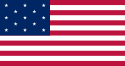


The Northwest Territory, too known as the Old Northwest [a] and formally known equally the Territory Northwest of the River Ohio, was formed from unorganized western territory of the Usa after the American Revolutionary State of war. Established in 1787 by the Congress of the Confederation through the Northwest Ordinance, it was the nation's first post-colonial organized incorporated territory.
At the fourth dimension of its creation, the territory included all the state west of Pennsylvania, northwest of the Ohio River and east of the Mississippi River below the Bully Lakes, and what later became known every bit the Boundary Waters. The region was ceded to the United States in the Treaty of Paris of 1783. Throughout the Revolutionary War, the region was part of the British Province of Quebec. It spanned all or large parts of six eventual U.Southward. states (Ohio, Indiana, Illinois, Michigan, Wisconsin, and the northeastern part of Minnesota). Reduced to nowadays-day Ohio, eastern Michigan and a sliver of southeastern Indiana with the formation of Indiana Territory July four, 1800, it ceased to exist March i, 1803, when the southeastern portion of the territory was admitted to the Spousal relationship as the state of Ohio, and the remainder attached to Indiana Territory.
Initially, the territory was governed by martial law under a governor and iii judges. As population increased, a legislature was formed as were a succession of counties, somewhen totaling thirteen. At the fourth dimension of its creation the Northwest Territory was a vast wilderness, long-populated by Native American cultures including the Delaware, Miami, Potawatomi, Shawnee and others; in that location were only a handful of French colonial settlements, plus Clarksville at the Falls of the Ohio. Past the fourth dimension of the territory's dissolution, there were dozens of towns and settlements, a few with thousands of settlers, chiefly forth the Ohio and Miami Rivers and the s shore of Lake Erie in Ohio. Conflicts between settlers and Native American inhabitants of the Territory resulted in the Northwest Indian State of war culminating in General "Mad" Anthony Wayne's victory at Boxing of Fallen Timbers in 1794. The subsequent Treaty of Greenville in 1795 opened the manner for settlement of southern and western Ohio.
Area [edit]
The Northwest Territory included all the and so-owned land of the United States w of Pennsylvania, east of the Mississippi River, and northwest of the Ohio River. It incorporated nigh of the former Ohio Country except a portion in western Pennsylvania, and eastern Illinois Country. It covered all of the modern states of Ohio, Indiana, Illinois, Michigan, and Wisconsin, besides as the northeastern part of Minnesota. Lands west of the Mississippi River were the Louisiana Province of New Spain, formerly New France (acquired by the United States in 1803 by the Louisiana Purchase); lands north of the Slap-up Lakes were the British Province of Upper Canada, and lands south of the Ohio River constituted Kentucky County, Virginia, admitted to the union as the country of Kentucky in 1792. The area included more than 300,000 foursquare miles (780,000 km2) and comprised nigh 1/3 of the land area of the United States at the time of its creation. It was inhabited by about 45,000 Native Americans and 4,000 traders, mostly Canadien and British. Among the tribes inhabiting the region were the Shawnee, Delaware, Miami, Wyandot, Ottawa and Potawatomi. Notably, the Miami capital forth with British trading posts was at Kekionga at the site of present-day Fort Wayne, Indiana. Neutralizing Kekionga became the focus of the Northwest Indian War, the driving events in the early development of the territory.
History [edit]
Integration of the Northwest Territory into a political unit of measurement, and settlement, depended on three factors: relinquishment by the British, extinguishment of states' claims west of the Appalachians, and usurpation or purchase of lands from the Native Americans. These objectives were accomplished correspondingly by the American Revolutionary War, provisions in the Articles of Confederation, and various treaties preceding the Northwest Indian War including Treaty of Fort Stanwix (1784) and Treaty of Fort McIntosh (1785). The treaty process extended well across the War and existence of the Territory as a political entity.
New France [edit]
European exploration of the region began with French-Canadian voyageurs in the 17th century, followed by French missionaries and French fur traders. French-Canadian explorer Jean Nicolet was the first recorded European entrant into the region, landing in 1634 at the electric current site of Light-green Bay, Wisconsin (although Étienne Brûlé is stated past some sources every bit having explored Lake Superior and possibly inland Wisconsin in 1622). The French exercised control from widely separate posts in the region, which they claimed as New French republic; among these was the post at Fort Detroit, founded in 1701. France ceded the territory to the Kingdom of Dandy United kingdom of great britain and northern ireland as part of the Indian Reserve in the 1763 Treaty of Paris, after existence defeated in the French and Indian War.
British control [edit]
From the 1750s to the peace treaty that ended the War of 1812, the British had a long-standing goal of creating an Indian barrier state, a big Native American state that would comprehend most of the Former Northwest. Information technology would be independent of the United States and allied with the British authorities, who would use it to block American west expansion and to build up their control of the fur trade headquartered in Montreal.[3]
A new colony, named Charlotina, was proposed for establishment in the southern Neat Lakes region before the events of Pontiac'due south War, after which the Crown issued the Proclamation of 1763, which prohibited white colonial settlement due west of the Appalachian Mountains. This activeness angered American colonists interested in expansion, equally well as those who had already settled in the area. In 1774, by the Quebec Act, Britain annexed the region to the Province of Quebec in order to provide a civil government and to centralize British administration of the Montreal-based fur trade. The prohibition of settlement west of the Appalachians remained, contributing to the American Revolution.
In Feb 1779, George Rogers Clark of the Virginia Militia captured Kaskaskia and Vincennes from British commander Henry Hamilton. Virginia capitalized on Clark'southward success by laying claim to the whole of the Old Northwest, calling it Illinois County, Virginia,[4] until 1784, when it ceded its land claims to the federal regime.
Britain officially ceded the expanse north of the Ohio River and w of the Appalachians to the U.s.a. at the end of the American Revolutionary War with the Treaty of Paris (1783), merely the British continued to maintain a presence in the region equally late every bit 1815, the finish of the War of 1812.
Cessions by the states [edit]
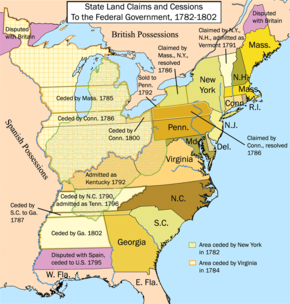
The land cessions that eventually allowed for the creation of the territories north and southwest of the River Ohio
Several states (Virginia, Massachusetts, New York, and Connecticut) had competing claims on the territory: Virginia claimed all of what were formerly Illinois Land and Ohio Country; Massachusetts claimed what are today southern Michigan and Wisconsin; Connecticut claimed a narrow strip across the territory just south of the Great Lakes; New York claimed an elastic portion of Iroquois lands between Lake Erie and the Ohio River. The western purlieus of Pennsylvania was also ill-defined. Virginia'due south jurisdiction was express to a few French settlements at the farthermost western edge of the territory. Massachusetts'south and Connecticut's claims were effectively lines on paper. New York had no colonial settlements or territorial government in the claimed lands.
The western edge of Pennsylvania, previously assumed to run in a northward by northeast zigzag, was resolved in 1780 by the Continental Congress. The Mason–Dixon line was extended westward to a betoken 5 degrees of longitude (about 260 miles) from the Delaware River and the western boundary extended to run due north from the westernmost extent of the Mason–Dixon line to the 43rd parallel. This incorporated the eastern function of Ohio Land equally western Pennsylvania, and gear up the eastern boundary of federal lands.
"Unlanded" states, such as Maryland, refused to ratify the Articles of Confederation and so long equally these states were allowed to keep their western territory, fearing that those states could continue to grow and tip the balance of power in their favor under the proposed system of federal government. As a concession to obtain ratification, these states ceded their claims on the territory to the federal regime: New York in 1780, Virginia in 1784, and Massachusetts and Connecticut in 1785. And then the majority of the territory became public country endemic past the U.S. regime. Virginia and Connecticut reserved two areas to use as compensation to military veterans: The Virginia War machine District[5] and the Connecticut Western Reserve[6]
Thomas Jefferson's State Ordinance of 1784 was the first organisation of the territory by the United states; information technology provided a process for dividing the territory into individual states. The State Ordinance of 1785 established a standardized arrangement for surveying the land into saleable lots, although Ohio was partially surveyed several times using dissimilar methods, resulting in a patchwork of land surveys in Ohio. Some older French communities' property claims based on earlier systems of long, narrow lots also were retained. The rest of the Northwest Territory was divided into roughly uniform square townships and sections, which facilitated land sales and development. The ordinance also stipulated that the territory would eventually course three to 5 new states.[seven]
Founding [edit]

Check signed by Arthur St. Clair while governor of the Northwest Territory (1796)
Under the Northwest Ordinance of 1787, which created the Northwest Territory, General St. Clair was appointed governor. When the territory was divided in 1800, he briefly served as governor of the Northwest Territory remnant that included Ohio, the eastern one-half of Michigan, and a sliver of southeastern Indiana called "The Gore."
St. Clair formally established the government on July fifteen, 1788, at Marietta. In 1790, he renamed the settlement of Losantiville Cincinnati, after the Society of the Cincinnati, and moved the authoritative and military heart to Fort Washington.
Every bit Governor, he formulated the Maxwell'south Code (named later on its printer, William Maxwell), the outset written criminal and civil laws of the territory. Maxwell'south Lawmaking consisted of thirty-vii different laws with the stipulation that the laws had to have been passed previously in one of the original thirteen states. The laws restructured the court system then in issue in the Northwest Territory. They besides protected residents against excessive taxes and declared that English common police force would be the basis of legal decisions and laws in the Northwest Territory.
Northwest Indian War [edit]

Map showing the general distribution of Native American tribes in the Northwest Territory in the early 1790s.
The young United States government, deeply in debt following the Revolutionary War and lacking authority to tax under the Articles of Confederation, planned to raise revenue from the methodical sale of land in the Northwest Territory. This plan necessarily called for the removal of both Native American villages and squatters from lands westward of Appalachia, loosely, the territory called "Ohio Land" and beyond.[8] Difficulties with Native American tribes and a supporting British military presence presented continuing obstacles for American expansion.
The surface area making up the Ohio Country had been contested for over a century, beginning with the 17th-century Beaver Wars. The Western Confederacy, or Western Indian Confederacy, was a loose confederacy of Native Americans in the Keen Lakes region of the Usa created post-obit the American Revolutionary War. Congress passed the Proclamation of 1783, which recognized Native American rights to the country. A council held in 1785 at Fort Detroit declared that the confederacy would bargain jointly with the United States, forbade private tribes from dealing directly with the United states, and alleged the Ohio River as the boundary between their lands and those of the American settlers.[9]
The Northwest Territory'south outset governor, Arthur St. Clair, sought to end Native American claims to Ohio land and thus clear the way for white settlement. In 1789, he succeeded in getting certain Native Americans to sign the Treaty of Fort Harmar, simply many native leaders had not been invited to participate in the negotiations or had refused to do so. Rather than settling the Native Americans' claims, the treaty provoked an escalation of the "Northwest Indian War" (or "Footling Turtle's War"). Common hostilities led to a campaign by General Josiah Harmar, whose 1,500 militiamen were defeated by the Native Americans in October 1790.[10]
A group of squatters had moved up to the area near present-24-hour interval Stockport now in Morgan County, Ohio and settled forth flood obviously, or "lesser" land, of the Muskingum River, some 30 miles north of an Ohio Visitor of Assembly settlement at Marietta, Ohio.The Big Lesser massacre occurred on January 2, 1791. Lenape and Wyandot warriors stormed the incomplete blockhouse and killed eleven men, one adult female, and ii children. (Accounts vary as to the number of casualties.) Rufus Putnam wrote to President Washington that "we shall be so reduced and discouraged every bit to requite up the settlement [Marietta following the Big Bottom disaster]."[11]
In March 1791, St. Clair succeeded Harmar as commander of the United States Army and was commissioned as a major full general. He led a punitive expedition involving two Regular Ground forces regiments and some militia. In Oct 1791 as an advance mail for his campaign, Fort Jefferson (Ohio), was built under his direction. Located in nowadays-twenty-four hours Darke County in far western Ohio, the fort was built of woods and intended primarily equally a supply depot; accordingly, it was originally named Fort Deposit. One month subsequently, near mod-day Fort Recovery, his forcefulness advanced to the location of Native American settlements near the headwaters of the Wabash River, but on Nov 4 they were routed in battle by a tribal confederation led by Miami Chief Little Turtle and Shawnee chief Blue Jacket. More than 600 soldiers and scores of women and children were killed in the battle, known every bit "St. Clair's Defeat" and many other names. It remains the greatest defeat of a The states Regular army past Native Americans in history, with about 623 American soldiers killed in action and about 50 Native American killed. Although an investigation exonerated him, St. Clair resigned his regular army commission in March 1792 at the request of President Washington, but connected to serve as Governor of the Northwest Territory.[12] [13] [fourteen]
| | This article is missing information about failed peace negotiations at Councils on the Auglaize fall 1792 & jump 1793. (January 2019) |

After St. Clair's ignominious defeat, In June 1792, President Washington tapped revolutionary war hero Major Full general "Mad" Anthony Wayne to avenge St. Clair and affirm sovereignty over the western borderland. Wayne was deputed to class a new ground forces of 5120 professional soldiers, dubbed the "Legion of the United states of america". Wayne recruited and trained his army in Pennsylvania, and moved them to southwestern Ohio in fall of 1793. There they were joined by the Kentucky Militia under Major Full general Charles Scott. Over the side by side ten months, the armies marched north up the Groovy Miami and Maumee River valleys toward the Miami capital of Kekionga. Forth the way Wayne's legion built a series of outpost forts including Fort Greene Ville, Fort Recovery and Fort Defiance. Trigger-happy battles occurred around some of these but none of Wayne'due south forts were always taken by the Native Americans.
| | This article is missing information about siege of Fort Recovery summer 1794. (January 2019) |
In mid 1794, the British built Fort Miamis about what is today Toledo, Ohio, to forestall Wayne's putative accelerate on the British stronghold at Detroit. The terminal battle of Wayne'southward campaign occurred within the telescopic of this fort. The military campaign of Gen. Wayne confronting the Western Confederacy, who were supported by a company of troops from Lower Canada, culminated with victory at the Battle of Fallen Timbers in 1794. Post-obit the battle, in fall 1794, Wayne's army marched unopposed to Kekionga where they synthetic Fort Wayne, a defiant symbol of U.Southward. sovereignty in the heart of Native American Country.
Jay'southward Treaty, in 1794, temporarily helped to shine relations with British traders in the region, where British citizens outnumbered American citizens throughout the 1790s. The following year, the Treaty of Greenville secured peace on the western frontier and opened most of southern and eastern Ohio for American settlement.
Settlement [edit]
| Yr | Pop. | ±% |
|---|---|---|
| 1792 | seven,920 | — |
| 1800 | 45,365 | +472.8% |
| Source: 1792;[15] 1800 (includes just Ohio and Wayne County, Michigan)[sixteen] [17] [18] [19] | ||
Sporadic westward emigrant settlements had already resumed tardily in the war[ which? ] after the Iroquois Confederacy'south power was cleaved and the tribes scattered by the 1779 Sullivan Expedition. Soon afterwards the Revolution ended, land-hungry migrants started moving west. A gateway trading post adult as the boondocks of Brownsville, Pennsylvania, which was a key outfitting center west of the mountains. Other wagon roads, such every bit the Kittanning Path surmounting the gaps of the Allegheny in central Pennsylvania, or trails along the Mohawk River in New York, enabled a steady stream of settlers to achieve the nearly west and the lands adjoining the Mississippi.[b] This activity stimulated the development of the eastern parts of the eventual National Road by private investors. The Cumberland–Brownsville toll road linked the water routes of the Potomac River with the Monongahela River of the Ohio/Mississippi riverine systems in the days when water travel was the only skilful alternative to walking and riding. Most of the territory and its successors was settled by emigrants passing through the Cumberland Narrows, or along the Mohawk Valley in New York Land.
The Continental Congress' title to the lands north of the Ohio River was derived from the Treaty of Paris (1783), the Treaty of Fort McIntosh, and the cessions of 4 states. Settlement was through several means: squatters, direct U.Due south. regime land sales to settlers, sales of tracts of state to land companies, and state sales of land to veterans in the Virginia Armed forces Commune and Connecticut Western Reserve. The starting time area to be surveyed was the Seven Ranges forth the eastern border of Ohio in 1786–1789. Directly sales of federal lands to individual homesteaders started hither. In some cases, the government granted or donated country for special purposes.
Settlement followed the forts, whether garrisoned or non. Lack of a garrison meant that threat of Native American attack had get negligible. This was true everywhere in Ohio before 1800 except the northwest sector above the Greenville Treaty line. It became true in Indiana later on the Battle of Tippecanoe in 1811; past 1813 Boxing of the Thames where Tecumseh was defeated and killed, the frontier had essentially moved to west of the Mississippi. The first U.Southward. war machine garrisons in the territory were Fort Patrick Henry, Vincennes, Indiana (1779), Fort Clark at Falls of the Ohio, Indiana (1783), and Fort Harmar in Ohio (1785). The first settlements were at these locations.
The first state grant was to George Rogers Clark in 1781 at Falls of the Ohio on the Indiana side; he went on to found the settlement of Clarksville. The outset two country purchases were large tracts of state sold to John Symmes (Symmes Buy) in 1788 and two tracts sold to Ohio Company in 1787 and 1792 (Purchase on the Muskingum). Settlement of these areas was spearheaded by Losantiville and Marietta, respectively. In 1792, Congress donated 100,000 acres to Ohio Company as a buffer zone against Native American incursion around the settled area. The vexing country claims past inhabitants of the old French Vincennes Tract were finally resolved by what was dubbed the 'Vincennes donation lands' embodied in a federal country act of 1791. Federal land sales in Indiana (so a part of Indiana Territory starting in 1800) began in 1801, through the Cincinnati land office.
Subsequently the Revolutionary War concluded, Rufus Putnam (the "Father of Ohio") and Manasseh Cutler were instrumental in creating the Northwest Ordinance,[20] which opened up the Northwest Territory for settlement. This land was used to serve as compensation for what was owed to Revolutionary State of war veterans. It was at Putnam's recommendation that the land was surveyed and laid out in townships of half-dozen miles foursquare. He organized and led the first group of veterans to the territory. They settled at Marietta, Ohio, where they built a large fort called Campus Martius.[21] [22] [23]
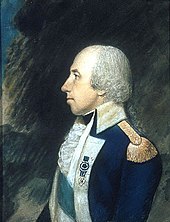
Putnam and Cutler insisted the Northwest Territory be a costless territory, with no slavery. They were both from Puritan New England, and the Puritans strongly believed that slavery was morally wrong. The Northwest Territory doubled the size of the United states, and establishing information technology as costless of slavery proved to be of tremendous importance in the following decades. Information technology encompassed what became Ohio, Indiana, Illinois, Michigan, Wisconsin and part of Minnesota.
Putnam, in the Puritan tradition, was influential in establishing education in the Northwest Territory. Substantial amounts of state were set aside for schools. Putnam had been one of the principal benefactors in the founding of Leicester Academy in Massachusetts, and similarly, in 1798, he created the plan for the construction of the Muskingum Academy (now Marietta College) in Ohio. In 1780, the directors of the Ohio Company appointed him superintendent of all its affairs relating to settlement north of the Ohio River. In 1796, he was commissioned by President George Washington equally Surveyor-General of United states of america Lands. In 1788, he served equally a judge in the Northwest Territory'south showtime court. In 1802, he served in the convention to form a constitution for the State of Ohio.[24] [25] [26]
In the 1800 United States census, following the passage of an organic human action by the 6th U.South. Congress creating the Indiana Territory in 1800, vii counties in the Northwest Territory reported the post-obit population counts:[16] [17] [xviii] [19]
| Rank | Canton | Population |
|---|---|---|
| 1 | Hamilton | 14,692 |
| ii | Jefferson | 8,766 |
| 3 | Ross | 8,540 |
| 4 | Washington | v,427 |
| 5 | Adams | three,432 |
| half dozen | Wayne | 3,206 |
| 7 | Trumbull | 1,302 |
| Northwest Territory | 45,365 |
According to the 1800 Census of the The states, the Northwest Territory (i.e. the pending state of Ohio) had a population, excluding Native Americans, of over 45,000, and Indiana Territory, a population of nigh 5,600. By the fourth dimension of Ohio statehood, there were as many as 50 named towns in Northwest and Indiana Territories, a few, like Vincennes, with thousands of settlers, and dozens of unnamed settlements below the Treaty Line in Ohio.
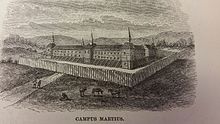
Campus Martius ("Field of Mars" in Latin) was named afterwards the part of Rome of the same proper noun. This site, including the Rufus Putnam House, is at present part of the Campus Martius Museum in Marietta, Ohio.[27]
Post-obit settlement of the frontier, the great wave of colonial clearing flowed westward, founding the cracking cities of the eventual 6 states of the Territory which is now the midwestern United States early in the 19th century: Detroit (<1800), Cleveland (1796), Columbus (1812), Indianapolis (1822), Chicago (1833), Milwaukee (1846), Minneapolis (1847).
Statehood for Ohio [edit]
A Federalist, St. Clair hoped to see two states fabricated of the old Ohio Country to increase Federalist power in Congress.[ commendation needed ] He was resented by Ohio Democratic-Republicans for his apparent partisanship, loftier-handedness and arrogance in function. In 1802, his opposition to plans for Ohio statehood led President Thomas Jefferson to remove him from office as territorial governor. He thus played no part in the organizing of the state of Ohio in 1803. The commencement Ohio Constitution provided for a weak governor and a strong legislature, in part a reaction to St. Clair'due south method of governance.
In preparation for Ohio's statehood, Congress divide the Northwest Territory into two sections in 1800. A new territory, Indiana Territory, encompassed all land west of the present Indiana–Ohio border and its due north extension to Lake Superior, except for a wedge-shaped area of nowadays-day Indiana in the southeast known as "the gore". Information technology, along with everything east of the new territory remained part of the Northwest Territory.[28] This legislation was signed into law by President John Adams on May 7, 1800, and became constructive on July 4. Later, on Apr 30, 1802, Congress passed an enabling act for Ohio that authorized the residents of the eastern portion of the Northwest Territory to form a country constitution and regime, and be admitted to the Union.[29] When Ohio was admitted as the 17th state on March one, 1803, the state non included in the new state, including the gore, became part of Indiana Territory, and the Northwest Territory went out of existence.[28]
Ongoing disputes with the British over the region were a contributing factor to the War of 1812. Britain irrevocably ceded claim to the former Northwest Territory with the Treaty of Ghent in 1814.
Northwest Ordinance [edit]
The Northwest Ordinance of 1787 established the Northwest Territory, and defined its boundaries, grade of government, and administrative structure. In particular, information technology defined the bodies of authorities, established the legal footing of land ownership, provided for abolition and transfer of country territorial claims, fabricated rules for admission of new states, established public education, recognized and codified 'natural rights', prohibited slavery, and defined the state rights and applicability of laws to the Native Americans.
Police force and government [edit]

Map of the states and territories of the Us as it was on August 7, 1789, when the Northwest Territory was outset organized, to April 2, 1790, when the future Southwest Territory was ceded by North Carolina
At first, the territory had a modified form of martial law. The governor was as well the senior army officer within the territory, and he combined legislative and executive authority. Just a supreme courtroom was established, and he shared legislative powers with the court. County governments were organized as shortly as the population was sufficient, and these assumed local authoritative and judicial functions. Washington County was the kickoff of these, at Marietta in 1788. This was an important event, as this court was the first establishment of civil and criminal law in the pioneer land.
As soon as the number of gratis male person settlers exceeded 5,000, the territorial legislature was to be created, and this happened in 1798. The full mechanisms of authorities were put in place, as outlined in the Northwest Ordinance. A bicameral legislature consisted of a House of Representatives and a Quango. The starting time Firm had 22 representatives, apportioned past population of each county.[30] The House and so nominated 10 citizens to exist Council members. The nominations were sent to the U.Due south. Congress, which appointed v of them as the council. This assembly became the legislature of the Territory, although the governor retained veto power.
Article Six of the Manufactures of Meaty inside the Northwest Ordinance prohibited the owning of slaves inside the Northwest Territory. Territorial governments evaded this police force by employ of indenture laws.[31] The Articles of Compact prohibited legal discrimination on the ground of religion within the territory.
The township formula created by Thomas Jefferson was first implemented in the Northwest Territory through the Land Ordinance of 1785. The square surveys of the Northwest Territory became a hallmark of the Midwest, every bit sections, townships, counties (and states) were laid out scientifically, and land was sold speedily and efficiently (although not without some speculative aberrations).
Officials [edit]
Arthur St. Clair was the territory'southward governor until November 1802, when President Thomas Jefferson removed him from role and appointed Charles Willing Byrd, who served the position until Ohio became a state and elected its kickoff governor, Edward Luncheon, on March 3, 1803.[32] The Supreme Courtroom consisted of (1) John Cleves Symmes; (2) James Mitchell Varnum, who died in 1789, replaced by George Turner, who resigned in 1796, and was replaced past Return Jonathan Meigs, Jr.; and (3) Samuel Holden Parsons, who died in 1789, replaced by Rufus Putnam, who resigned 1796, and was replaced by Joseph Gilman.[33] There were iii secretaries: Winthrop Sargent (July 9, 1788 – May 31, 1798); William Henry Harrison (June 29, 1798 – December 31, 1799); and Charles Willing Byrd (Jan 1, 1800 – March 1, 1803).
The territory's first common pleas court opened at Marietta on September two, 1788. Its first judges were Full general Rufus Putnam, General Benjamin Tupper, and Colonel Archibald Crary. Ebenezer Sproat was the first sheriff, Paul Fearing became the first attorney to do in the territory, and Colonel William Stacy was foreman of the first m jury.[34] Griffin Greene was appointed justice of the peace.
Full general Assembly [edit]
The General Assembly of the Northwest Territory consisted of a Legislative Council (five members chosen by Congress) and a House of Representatives consisting of 22 members elected by the male person freeholders in 9 counties. The showtime session of the Associates was held in September 1799. Its first important task was to select a non-voting delegate to the U.S. Congress. Locked in a power struggle with Governor St. Clair, the legislature narrowly elected William Henry Harrison every bit the get-go delegate over the governor's son, Arthur St. Clair, Jr. Subsequent congressional delegates were William McMillan (1800–1801) and Paul Fearing (1801–1803).
Country buying [edit]
The Northwest Ordinance of 1787 established the concept of fee elementary ownership, by which ownership was in perpetuity with unlimited power to sell or give it away.
Prohibition of slavery [edit]
The ordinance was the first of its kind in prohibiting slavery in a U.S. territory.
Native American lands [edit]
In regards to the Delaware Native Americans living in the region, Congress decided, on July 27, 1787, that 10,000 acres on the Muskingum River in the present country of Ohio would "be set apart and the property thereof be vested in the Moravian Brethren . . . or a order of the said Brethren for civilizing the Native Americans and promoting Christianity."[35]
Education [edit]
The Northwest Ordinance called for a public university for the instruction, settlement and eventual statehood of the frontier of Ohio and beyond. Commodity iii stated, "Religion, morality, and knowledge being necessary to good government and the happiness of mankind, schools and the means of education shall forever be encouraged." The Land Ordinance of 1785 created an innovation in public didactics when it reserved resources for local public schools. The ordinance divided the territory into 36 miletwo townships, and each township was further divided into 36 ane mileii tracts for purposes of sale. The ordinance then stated that "there shall be reserved from sale the lot No. 16 of every township for the maintenance of public schools within the said township."[36]
In 1801, Jefferson Academy was established in Vincennes. As Vincennes University, information technology remains the oldest public institution of higher learning in the Northwest Territory.
The next year, American Western University was founded in Athens, Ohio, upstream of the Hocking River, due to its location directly between Chillicothe (an original uppercase of Ohio) and Marietta. Information technology was formally established on February 18, 1804, as Ohio Academy.[37]
Settlements and forts [edit]
Forts, garrisons and settlements established in the territory northwest of the River Ohio between 1778–1803 (excluding those established in Indiana Territory afterwards 1800). They are listed by present-24-hour interval location and year established or of U.S. possession. Near forts were armed forces garrisons merely. General Anthony Wayne, during his Ohio State campaign 1792–1795, built or rebuilt 10 such forts: forts (in gild by engagement) Lafayette,[38] Greene Ville, Recovery, Adams, Definance, Deposit, Wayne, Loramie, Piqua, and St. Mary's. Early settlements were outside or nearby forts: Clarksville, Vincennes, Kaskaskia (French), Losantiville, and the Ohio Company settlements at Marietta and Waterford/Beverly. Later, subsequently the Treaty of Greenville, settlements no longer needed to exist spearheaded past forts, and sprang up chop-chop beneath the Treaty Line.
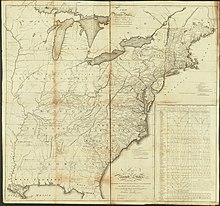
Abraham Bradley's 1796 map of the United States includes many forts and settlements within the Northwest Territory.
- Fort Laurens (aka Lawrence), Ohio, 1778, now Bolivar
- Cahokia, Illinois, 1778
- Fort Gage, Kaskaskia, Illinois, 1779, an American / French settlement
- Fort Patrick Henry, Vincennes, Indiana 1779
- Clarksville, Indiana, 1783 (opposite Fort Nelson, Virginia, now Louisville, Kentucky)
- Fort Finney, Ohio, 1785, abandoned 1786 / 1787
- Fort Harmar, Ohio, 1785
- Norristown, 1785; reestablished as Jefferson, 1795, now Martins Ferry
- Fort Finney, Indiana, 1786, renamed Fort Steuben in 1791; now Jeffersonville
- Fort Steuben, Ohio, Jan 1787, abandoned May 1790
- Steubenville Ohio, 1797
- Marietta, Ohio, July 1788
- Columbia, Ohio, November 1788
- Losantiville (Cincinnati), Ohio, December 1788
- Due north Bend, Ohio, February 1789
- Waterford and Beverly, Ohio, leap 1789
- Fort Washington, Ohio, summer 1789 (afterwards relocated and became the Newport Barracks, KY)
- Massie's Station, Virginia Military Commune, 1790, renamed Manchester
- Fort Dilles, Ohio, 1790, afterward called Dilles Bottom
- Gallipolis, Ohio, Oct 1790
- Big Lesser, Ohio, December 1790 (squatter settlement, site of Big Lesser Massacre in 1791)
- Fort Frye, Ohio, January – February 1791 (not a U.S. military garrison)
- Fort Hamilton, Ohio, September 1791
- Fort Jefferson, Ohio, Oct 1791 (originally Fort Deposit)
- Fort St. Clair, Ohio, 1792
- Fort Greene Ville, Ohio, November 1793
- Fort Recovery, Ohio, December 1793 – March 1794
- Fort Adams, Ohio, August 1794
- Fort Massac, Illinois, June – October 1794
- Fort Disobedience, Ohio, August 1794 (Battle of Fallen Timbers, August 1794)
- Fort Deposit, Ohio, September – Oct 1794
- Fort Wayne, Indiana, October 1794
- Fort Loramie (or Laramie), Ohio, winter 1794–95
- Fort Piqua, Ohio, winter 1794–95
- Fort St. Mary's, Ohio, October 1795
- Chillicothe, Ohio, 1796
- Cleveland, Connecticut Western Reserve, 1796
- Fort Miami, Ohio (British held until 1796)
- Fort Lernoult (previously Fort Detroit), Michigan (British held until 1796)
- Fort Mackinac, Michigan (British held until 1796)
- Williamsburg, Ohio, 1796
- Dayton, Ohio, 1796
- Newellstown, Ohio, 1796, renamed St. Clairsville
- Athens, Ohio, 1797
- Franklinton, Ohio, 1797
- Mentor, Ohio, 1797
- Warren, Ohio, 1798
- Bethel, Ohio, 1798
- Westbourne, Ohio, 1799, renamed Zanesville in 1801
- Lancaster, Ohio, 1800
- Springfield, Ohio, 1801
- Youngstown, Ohio, 1802
- Coshocton, Ohio, 1802
- Lawrenceburg, Indiana, 1802 (Inside the Northwest Territory'due south Hamilton Canton until 1803)
- New Lisbon, Ohio, 1803, later renamed Lisbon
- Xenia, Ohio, 1803
Counties [edit]
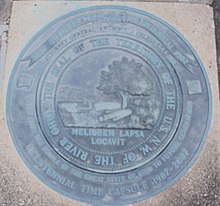
Seal of the Northwest Territory over a time capsule outside the Campus Martius Museum. The Latin phrase, "He has planted i ameliorate than the one fallen," signifies the replacement of wilderness by civilization.[39]

Territorial county of Wayne
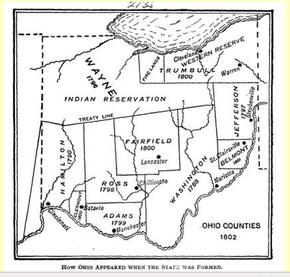
Thirteen counties were formed past Governor Arthur St. Clair during the territory's existence:
- Washington County, with its seat at Marietta, was the first canton formed in the territory, proclaimed on July 26, 1788, by territorial governor St. Clair. Its original boundaries were proclaimed as all of present-day Ohio eastward of a line extending due south from the mouth of the Cuyahoga River,[40] merely this did not take into account Connecticut's still unresolved claim of the Western Reserve. Information technology kept these boundaries until 1796.
- Hamilton Canton, with its seat at Cincinnati, was proclaimed on Jan ii, 1790. The aforementioned proclamation officially inverse Cincinnati's name from Losantiville into its nowadays course. Its original boundaries claimed all land north of the Ohio River betwixt the Bully Miami River and Niggling Miami River equally far north as Standing Rock Fork (now Loramie Creek), just due north of present-day Piqua.[41] In 1792 Hamilton Canton was expanded to comprehend all lands between the mouths of the Great Miami and Cuyahoga Rivers, as well every bit all of what is now the Lower Peninsula of Michigan. Its territory was reduced several times subsequently 1796.
- St. Clair County, with its seat at Kaskaskia was proclaimed on April 27, 1790. Information technology originally encompassed most of present-day Illinois south of the Illinois River. Information technology lost about of its southern lands in the formation of Randolph County in 1795, necessitating the transfer of the county seat to Cahokia, but expanded to the northward to take in northwest present-twenty-four hour period Illinois and most of present-day Wisconsin in 1801 subsequently becoming part of Indiana Territory.[42]
- Knox County, with its seat at Vincennes, was proclaimed on June twenty, 1790, and encompassed the majority of the territory'south land expanse – all land betwixt St. Clair County and Hamilton County, extending north to Canada.[43]
- Randolph Canton was formed Oct five, 1795, with its seat at Kaskaskia and encompassed the southern half of what was St. Clair County.
- Wayne Canton was formed on August 15, 1796, out of portions of Hamilton Canton and unorganized country, with its seat at Detroit, which had been evacuated by the British five weeks previously. Wayne County originally covered all of Michigan's Lower Peninsula, northwestern Ohio, northern Indiana and a pocket-sized portion of the present Lake Michigan shoreline, including the site of present-day Chicago. On November 1, 1798, information technology was separate into the four townships of Detroit, Hamtramck, Mackinaw, and Sargent.[44] The lands westward of the extension of the present Indiana-Ohio edge became part of Indiana Territory in 1800; the eastern portion of the county's land in Ohio were folded into Trumbull County that same year. The territory north of the Ordinance Line became part of Indiana Territory in 1803 as a reorganized Wayne County; the remainder reverted to unorganized status after Ohio statehood.
- Adams County was formed on July 10, 1797, with its seat at Manchester; it encompassed most of present-day due south-primal Ohio.
- Jefferson Canton was formed July 29, 1797, with its seat at Steubenville, carved out of Washington County and originally encompassed all of what is now northeastern Ohio.
- Ross Canton was organized on August twenty, 1798, with its seat at Chillicothe and was carved out of portions of Knox, Hamilton and Washington counties.
Knox, Randolph and St. Clair counties were separated from the territory effective July 4, 1800, and, along with the western part of Wayne County, and unorganized lands in what are at present Minnesota and Wisconsin, became the Indiana Territory.
- Trumbull County was proclaimed July 10, 1800, out of the Western Reserve portion of Jefferson and Wayne Counties, with its county seat at Warren, called over rivals Cleveland and Youngstown.[45]
- Clermont Canton was formed December 6, 1800, out of Hamilton County, with its seat at Williamsburg. In contrast with near other Northwest Territory counties, Clermont County's original boundaries are only slightly larger than its present-day limits.
- Fairfield County was proclaimed December ix, 1800, formed out of Ross and Washington counties, with its seat at Lancaster.
- Belmont County was proclaimed September seven, 1801, formed out of Washington and Jefferson counties, with its seat at St. Clairsville.
The Northwest Territory ceased to be upon Ohio statehood on March 1, 1803; the lands in Ohio that were previously part of Wayne Canton but non included in Trumbull County reverted to an unorganized status until new counties could exist formed. The remainder of Wayne County, roughly the eastern half of the Lower Peninsula of Michigan and the eastern tip of the Upper Peninsula, was attached to Indiana Territory. A sliver of Hamilton County along the southwestern border (the Greenville Treaty line) comprising a portion of the Whitewater River drainage basin and known every bit "The Gore" was also ceded to Indiana Territory.
See also [edit]
- One-time Southwest, analogous lands south of the Ohio River
- Louisiana Purchase, lands due west of the Mississippi River
- Historic regions of the United states
- Ohio Visitor
- Zane'due south trace
Notes [edit]
- ^ This term was a later and somewhat broader American term for the area to distinguish information technology from the Midwestern United States and/or the Pacific Northwest.
- ^ Before the 1803 Louisiana Purchase, the western border of U.South. territory concluded on the Mississippi; the lands beyond still being a possession of Napoleonic French republic or the Kingdom of Espana.
References [edit]
- ^ "Northwest Territory". HowStuffWorks. Archived from the original on January ane, 2014. Retrieved August 10, 2013.
- ^ C. Cong. 1787, 32:334
- ^ Dwight Fifty. Smith, "A North American Neutral Indian Zone: Persistence of a British Idea," Northwest Ohio Quarterly 61#two–4 (1989): 46–63.
- ^ Palmer, pp. 400–421.[ full citation needed ]
- ^ Virginia ceded to the U.s.a. its claim to undeeded country in the VMC on Dec. eight, 1852. In 1871, Congress ceded this land to the state.
- ^ In 1800, Connecticut ceded its Western Reserve claims to the Northwest Territory, and it came under the sovereignty of Ohio in 1803.
- ^ Calloway, Colin G. (2015). The Victory with No Name. The Native American Defeat of the Beginning American Army. Oxford Academy Press. p. l.
- ^ Calloway, Colin G. (2015). The Victory with No Name. The Native American Defeat of the Kickoff American Army. Oxford Academy Press. p. 38.
- ^ Keiper, Karl A. (2010). "12". Land of the Indians – Indiana. p. 53. ISBN9780982470312 . Retrieved July 26, 2019.
- ^ Michael S. Warner, "General Josiah Harmar's Campaign Reconsidered: How the Americans Lost the Boxing of Kekionga." Indiana Magazine of History (1987): 43–64. online
- ^ Winkler, John F. (2011). Wabash 1791: St. Clair'southward Defeat; Osprey Campaign Serial #240 . Oxford: Osprey Publishing. p. 15. ISBN978-i-84908-676-nine.
- ^ Leroy V. Eid, "American Indian Military Leadership: St. Clair's 1791 Defeat." Periodical of Military History 57.1 (1993): 71–88.
- ^ William O. Odo, "Destined for Defeat: an Analysis of the St. Clair Expedition of 1791." Northwest Ohio Quarterly (1993) 65#2 pp: 68–93.
- ^ John F. Winkler, Wabash 1791: St Clair's Defeat (Osprey Publishing, 2011)
- ^ Purvis, Thomas L. (1995). Balkin, Richard (ed.). Revolutionary America 1763 to 1800. New York: Facts on File. p. 178. ISBN978-0816025282.
- ^ a b Forstall, Richard L. (ed.). Population of united states and Counties of the Usa: 1790–1990 (PDF) (Report). United States Demography Bureau. pp. 47–49. Retrieved May 18, 2020.
- ^ a b Forstall, Richard L. (ed.). Population of the States and Counties of the U.s.a.: 1790–1990 (PDF) (Written report). United States Census Agency. pp. 51–53. Retrieved May xviii, 2020.
- ^ a b Forstall, Richard L. (ed.). Population of the States and Counties of the United states of america: 1790–1990 (PDF) (Written report). Us Census Agency. pp. 81–83. Retrieved May xviii, 2020.
- ^ a b Forstall, Richard Fifty. (ed.). Population of the States and Counties of the United States: 1790–1990 (PDF) (Study). United States Census Agency. pp. 125–127. Retrieved May 18, 2020.
- ^ McCullough, David (2019). The Pioneers. Simon & Schuster. ISBN1501168681.
- ^ Hubbard, Robert Ernest. General Rufus Putnam: George Washington'south Chief Armed services Engineer and the "Father of Ohio," pp. ii–iv, 45–8,105–18, McFarland & Company, Inc., Jefferson, North Carolina. ISBN 978-i-4766-7862-7.
- ^ Hildreth, Samuel Prescott. Biographical and Historical Memoirs of the Early Pioneer Settlers of Ohio, pp. 34–7, 63–4, Badgley Publishing Company, 2011. ISBN 978-0615501895.
- ^ McCullough, David. The Pioneers: The Heroic Story of the Settlers Who Brought the American Ideal Westward, pp. 46–7, Simon & Schuster, Inc., New York, New York, 2019. ISBN 978-1-5011-6870-3.
- ^ Hubbard, Robert Ernest. Full general Rufus Putnam: George Washington's Master Armed services Engineer and the "Begetter of Ohio," pp. 127–50, McFarland & Visitor, Inc., Jefferson, Due north Carolina. ISBN 978-i-4766-7862-7.
- ^ Hildreth, Samuel Prescott. Biographical and Historical Memoirs of the Early Pioneer Settlers of Ohio, pp. 69, 71, 81, 82, Badgley Publishing Visitor, 2011. ISBN 978-0615501895.
- ^ McCullough, David. The Pioneers: The Heroic Story of the Settlers Who Brought the American Ideal Due west, pp. 143–7, Simon & Schuster, Inc., New York, New York, 2019. ISBN 978-ane-5011-6870-3.
- ^ Lossing, Benson (1868). The Pictorial Field-Volume of the War of 1812. Harper & Brothers, Publishers. p. 37.
- ^ a b "Indiana Territory" (PDF). The Indiana Historian. Indianapolis, Indiana: Indiana Historical Bureau. March 1999. Retrieved March 14, 2021.
- ^ Pawlack, Tim. "Ohio: The 48th Country?". Ohio History Connection. Columbus Ohio: Ohio History Center. Retrieved March 14, 2021.
- ^ Ohio General Assembly (1917). Manual of Legislative Practice in the General Assembly. State of Ohio. p. 199.
- ^ "Slavery in Indiana Territory". Indiana Historical Bureau. Archived from the original on July 21, 2007. Retrieved July 24, 2013.
- ^ Burtner, Due west. H., Jr. (1998). "Charles Willing Byrd". 41. Ohio Historical Order: 237. [ permanent expressionless link ]
- ^ Force, Manning, ed. (1897). "The Supreme Court – a Historical Sketch". Bench and Bar of Ohio: a Compendium of History and Biography. Vol. 1. Chicago: Century Publishing and Engraving Company. p. five.
- ^ Hildreth, South. P. (1848). Pioneer History: Being an Business relationship of the Commencement Examinations of the Ohio Valley, and the Early Settlement of the Northwest Territory. Cincinnati, Ohio: H. W. Derby and Co. pp. 232–33.
- ^ "Religion and the Congress of the Confederation, 1774–89". Library of Congress. Retrieved November 4, 2012.
- ^ Knight, George Wells (1885). History, and Management of Land Grants for Education in the Northwest Territory (Ohio, Indiana, Illinois, Michigan, Wisconsin). G. P. Putnam's Sons. p. 13.
- ^ "Ohio University". Ohio History Key: An Online Encyclopedia of Ohio History. Retrieved December 31, 2009.
- ^ in PA, not the Northwest Territory per se
- ^ Reinke, Edgar C. "Meliorem Lapsa Locavit: An Intriguing Puzzle Solved". Ohio History. 94: 74. says the young tree on the seal of the NWT is an apple tree, while Summers, Thomas J. (1903). History of Marietta. Marietta, Ohio: Leader Publishing. p. 115. says information technology is a buckeye, and perhaps the genesis of Ohio's nickname.
- ^ Griswold, Due south.O. (1884). The Corporate Birth and Growth of the City of Cleveland. Western Reserve and Northern Ohio Historical Society. Tract No. 62.
- ^ Unknown (1894). History of Cincinnati and Hamilton County. S.B. Nelson & Co.
- ^ Walton, West.C. (1928). A Brief History of St. Clair County. McKendree College.
- ^ Esarey, Logan (1915). A History of Indiana. Westward.1000. Stewart Co. p. 137.
- ^ Fuller, George Newman (1924). Historic Michigan, country of the Bully Lakes; its life, resource, industries, people, politics, authorities, wars, institutions, achievements, the press, schools and churches, legendary and prehistoric lore. Dayton Ohio United: National Historical Association, Inc. p. 101.
- ^ "Historical Data for the Target Investment Areas Trumbull County and the Historic Western Reserve". Trumbull County. Archived from the original on March 20, 2005.
Farther reading [edit]
- Barr, Daniel P. The Boundaries Between Us: Natives and Newcomers Along the Frontiers of the Old Northwest Territory, 1750–1850 (Kent State University Press, 2006)
- Beatty-Medina, Charles, and Melissa Rinehart, eds. Contested Territories: Native Americans and Not-natives in the Lower Great Lakes, 1700–1850 (Michigan State University Printing, 2012)
- Buley, R. Carlyle. "Pioneer wellness and medical practices in the old northwest prior to 1840." Mississippi Valley Historical Review (1934): 497–520. in JSTOR
- Calloway, Colin G. The Victory with No Name: The Native American Defeat of the Kickoff American Army (Oxford University Press, 2014)
- Davis, James Due east. "" New Aspects of Men and New Forms of Guild": The Old Northwest, 1790–1820." Journal of the Illinois State Historical Club (1976): 164–172. in JSTOR
- Elkins, Stanley, and Eric McKitrick. "A Meaning for Turner's Frontier: Part I: Republic in the Old Northwest." Political Science Quarterly (1954): 321–353. in JSTOR
- Esarey, Logan. "Elements of Culture in the Former Northwest." Indiana Magazine of History (1957): 257–264. online
- Heath, William. William Wells and the Struggle for the Old Northwest (University of Oklahoma Press, 2015) he lived 1770–1812
- Kuhns, Frederck I., "Abode Missions and Education in the Former Northwest." Journal of the Presbyterian Historical Society (1953): 137–155. in JSTOR
- Owens, Robert Chiliad. Mr. Jefferson's hammer: William Henry Harrison and the origins of American Indian policy (University of Oklahoma Press, 2012)
- Ubbelohde, Carl. "History and the Midwest as a Region." Wisconsin Magazine of History (1994): 35–47. in JSTOR
Older sources [edit]
- Barker, Joseph (1958). Recollections of the Beginning Settlement of Ohio. Marietta, Ohio: Marietta Higher. Original manuscript written late in Joseph Barker's life, prior to his decease in 1843
- Gilkey, Elliot Howard, ed. (1901). The Ohio Hundred Year Book: a Manus-book of the Public Men and Public Institutions of Ohio ... Country of Ohio.
- Hildreth, South. P. (1848). Pioneer History: Being an Account of the Offset Examinations of the Ohio Valley, and the Early Settlement of the Northwest Territory. Cincinnati, Ohio: H. Westward. Derby and Co.
- Hildreth, Southward. P. (1852). Biographical and Historical Memoirs of the Early Pioneer Settlers of Ohio. Cincinnati, Ohio: H. W. Derby and Co.
- Hulbert, Archer Butler (1917). The Records of the Original Proceedings of the Ohio Company, Volumes I and 2. Marietta, Ohio: Marietta Historical Committee.
- Lindley, H.; Schneider, Northward. & Quaife, M. (1937). History of the Ordinance of 1787 and the Old Northwest Territory (A Supplemental Text for Schoolhouse Utilise). Marietta, Ohio: Northwest Territory Commemoration Commission.
- Morse, J. (1797). "North-West Territory". The American Gazetteer. Boston, Massachusetts: S. Hall, and Thomas & Andrews. OL 23272543M.
- Summers, Thomas J. (1903). History of Marietta. Marietta, Ohio: Leader Publishing.
External links [edit]
 Works related to The Northwest Ordinance at Wikisource
  Media related to Northwest Territory at Wikimedia Commons
- Facsimile of 1789 Act
- The Territory's Executive Journal
- Maumee Valley Heritage Corridor
- Prairie Fire: The Illinois Country 1673–1818, Illinois Historical Digitization Projects at Northern Illinois University Libraries Archived Baronial 25, 2007, at the Wayback Motorcar
Coordinates: 41°N 86°West / 41°N 86°West / 41; -86
Source: https://en.wikipedia.org/wiki/Northwest_Territory
Posted by: leewhost1949.blogspot.com
0 Response to "What Are 5 States That Makeup The Nw Territory"
Post a Comment